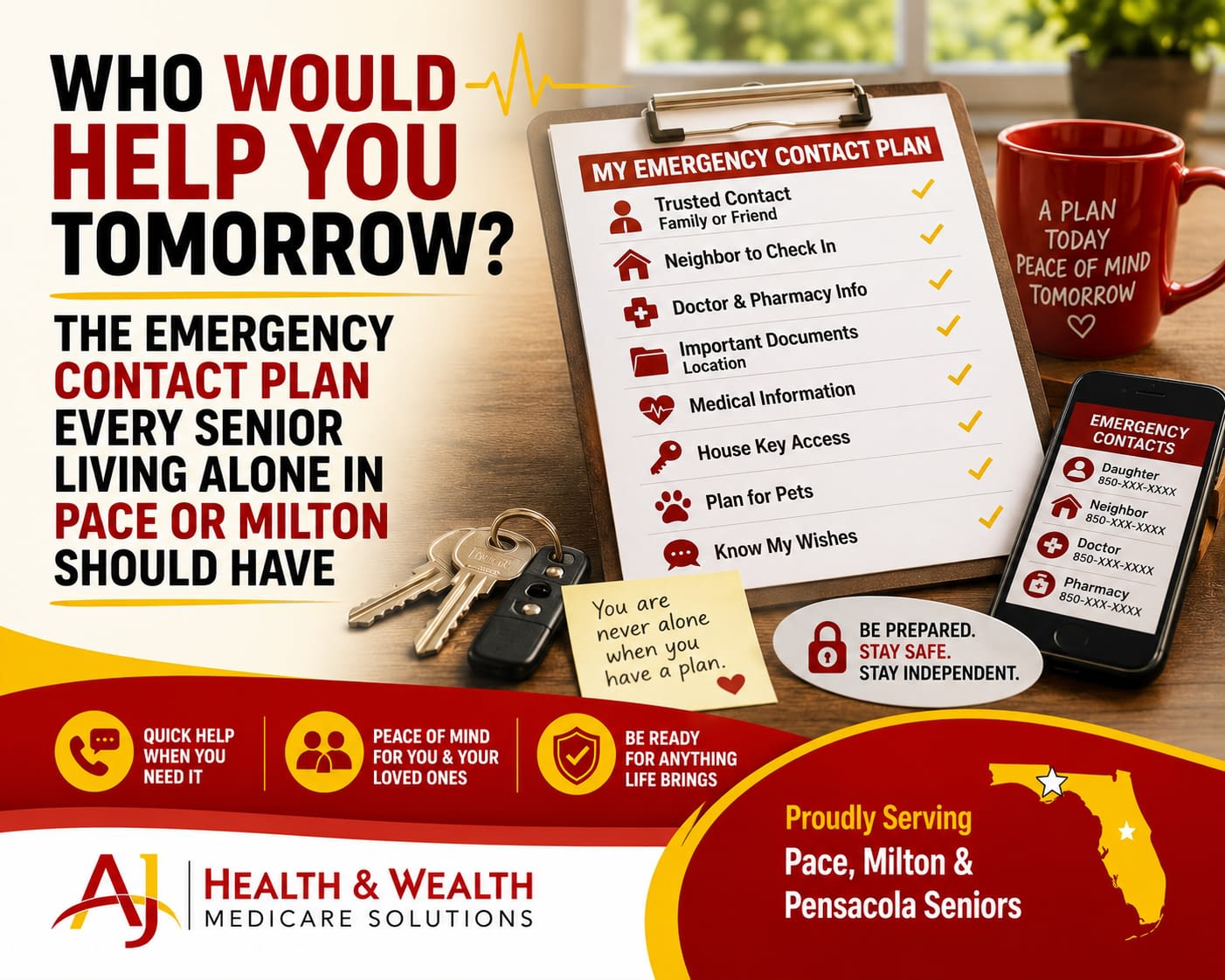
Living alone can be a wonderful form of independence. For many older adults in Pace, Milton, Pensacola, Jay, and Gulf Breeze, remaining at home is exactly where they want to be. But independence works best when there is a backup plan.
Imagine falling in the kitchen and being unable to reach the front door. Imagine being taken to the hospital while a dog is still at home. Imagine a hurricane knocking out power while family lives several states away. These are not reasons to give up independence. They are reasons to answer one practical question before a crisis: Who would help you tomorrow?
My name is Mark Garrett, and at AJ Health & Wealth I help local seniors understand Medicare. Real-life healthcare, however, is rarely limited to an insurance card. A good emergency plan also includes people, medications, transportation, pets, keys, and accurate information that someone can actually find and use.
1. Choose Two Contacts, Not Just One
Most people can name one emergency contact. The problem is that one person may be traveling, asleep, at work, sick, or simply unable to answer. Choose at least two trusted people.
Your first contact might be an adult child. Your second could be a nearby relative, neighbor, church friend, or longtime family friend. Ideally, at least one person should live close enough to physically reach your home. A daughter in another state may be the person you trust most, but she cannot unlock the front door in Pace within ten minutes. Make sure both contacts know they have been chosen and understand what you would want them to do.
2. Decide Who Can Get Into the Home
In an emergency, a locked door can become a serious obstacle. Ask who has a spare key and whether that person is usually nearby. Some families use a secure lockbox or another controlled access method. If you live in a gated community or apartment building, think about gate codes and building entry procedures. The goal is simple: a trusted person should be able to get inside when you genuinely need help.
3. Create a One-Page Emergency Information Sheet
This is the single most useful thing you can do today. Create a simple one-page sheet that includes:
- Full name and date of birth
- Two emergency contacts with phone numbers
- Primary care doctor and any specialists
- Pharmacy name and phone number
- Current medications and dosages
- Known allergies
- Major medical conditions
- Medicare and insurance information
- Pet information (food, vet, supplies location)
- Location of advance directives if applicable
Keep one copy in a clearly labeled folder — the refrigerator door is a location emergency responders often check. Give copies to both primary contacts. Update it whenever medications, doctors, or phone numbers change.
4. Make Sure Someone Knows About Your Medications
Do not rely only on bottles in the medicine cabinet. A prescription may have changed, a bottle may be outdated, or the label may not include context that matters in a crisis. Keep a current written list with medication name, dosage, and frequency.
If you use insulin, blood thinners, oxygen, dialysis, or other important treatments, make sure your contacts know. They do not need to become your doctor. They need enough accurate information to communicate clearly with healthcare professionals when it matters most.
5. Have a Pet Plan
For many seniors, the first worry after an ambulance arrives is the pet left at home. Choose someone who can feed, walk, or temporarily care for your animal. Make sure that person knows where food, medication, leashes, carriers, and veterinary information are kept. A pet plan gives you one less thing to worry about during a hospitalization or evacuation — and that peace of mind is worth something.
6. Build a Transportation Backup
What happens if you cannot drive for two weeks after surgery? Think through follow-up appointments, physical therapy, the pharmacy, and groceries.
Some Medicare Advantage plans may include limited transportation benefits for eligible medical trips, but benefits vary by plan. And Medicare ambulance coverage has specific medical-necessity rules — an ambulance is not a routine ride to the doctor. Know in advance who could drive you, and whether any community transportation programs serve your area.
7. Prepare for Hurricanes and Power Outages
In Northwest Florida, emergency planning and hurricane preparedness are the same conversation. Who will check on you if cell service is unreliable? Where would you go if you had to evacuate? Who would help with transportation? What happens to refrigerated medication or powered medical equipment such as a CPAP or oxygen concentrator?
Write down the plan before a storm enters the Gulf. A family member may assume you are evacuating while you assume they are coming to get you. Solve that misunderstanding on a sunny day, not when a Category 3 is approaching the Panhandle.
8. Create a Simple Check-In Routine
A daily text, phone call, or good-morning message can provide quiet reassurance. If the message does not arrive by a certain time, the contact knows to follow up.
The routine should fit your life naturally. The important part is a clear, shared expectation. “Call me sometime” is not a system. “If you do not hear from me by 10 a.m., call me and then my neighbor” is a system. Small and consistent beats elaborate and ignored.
9. Plan for What Happens After the ER
The emergency does not always end when you leave the hospital. You may need help with medications, meals, bathing, transportation, medical equipment, or follow-up appointments during recovery.
Medicare may cover certain medically necessary home health services when requirements are met, but it generally does not provide unlimited custodial care, housekeeping, or around-the-clock personal assistance. Your emergency plan should include recovery, not just the ambulance ride. Knowing the limits of your coverage before a hospitalization prevents difficult surprises at discharge.
10. Understand Permissions and Important Documents
An emergency contact is not automatically a healthcare decision-maker, a power of attorney, or a person authorized to access every record. Those are different roles with different legal standing.
Talk with appropriate healthcare and legal professionals about documents or permissions that may fit your situation. Make your wishes clear before a crisis, not during one.
11. Use Technology — But Keep a Paper Backup
Medical alert devices, smartwatches, fall detection, and emergency phone features can be valuable layers of protection. But technology can lose power, break, or become confusing under stress.
Use technology as one layer of the plan, not the entire plan. Keep paper copies of essential information and make sure a trusted person knows how your devices work and what to do if they fail.
12. Know Where to Turn for Local Help
The Northwest Florida Area Agency on Aging serves older residents in Escambia, Santa Rosa, Okaloosa, and Walton counties, providing information and referrals to community resources for seniors age 60 and older. Their Elder Helpline is available at (850) 494-7100, or toll-free at 1-866-531-8011.
The Council on Aging of West Florida serves seniors in Escambia and Santa Rosa counties through a range of in-home and community-based programs, and can be reached at (850) 432-1475.
You may not need those services today. Knowing they exist — and having the phone numbers written down — can make a difficult week considerably easier.
The Tomorrow Morning Test
If you were taken to the hospital tonight and could not make phone calls, ask yourself: Would someone know where you are? What medications you take? Who your doctors are? How to get into your home? How to care for your pet? Where your insurance information is? How you would safely get home after discharge?
Every “no” is a specific, fixable gap in the plan. Start there.
Frequently Asked Questions
Should a senior living alone have a medical alert device?
It can be helpful for some people, especially those with fall risk or limited nearby support. The best choice depends on individual needs, comfort with technology, and budget. A device works best as one layer of a larger plan.
Does Medicare pay for medical alert systems?
Original Medicare generally does not cover standard personal emergency response systems. Some Medicare Advantage plans may offer related benefits, but availability and coverage details vary by plan. Ask your plan directly what is included.
Does Medicare cover ambulance transportation?
Medicare may cover ambulance transportation when medical-necessity and other coverage requirements are met. It is not a general transportation benefit, and the rules are specific. If you have questions about how ambulance coverage works under your plan, I am happy to walk through it with you.
What if my family lives out of town?
Choose a combination of contacts. A distant family member can coordinate decisions and communicate with providers, while a trusted local neighbor or friend can reach your home quickly when needed. Both roles matter.
How AJ Health & Wealth Can Help
As a licensed independent Medicare broker serving Escambia and Santa Rosa counties, I help Medicare beneficiaries throughout Pace, Milton, Pensacola, Jay, Gulf Breeze, and surrounding Northwest Florida communities understand how their coverage works in real life — including emergency care, ambulance coverage, hospital stays, home health, medical equipment, and prescription coverage.
Medicare education should help people feel genuinely prepared, not just enrolled. If you have questions about how your coverage would work in an emergency, or if it has been a while since you reviewed your plan, I am happy to help.
| 📞 Call or Text: (850) 316-4378 📅 Schedule Online: calendly.com/ajhealthandwealth 🌐 Visit: ajhealthandwealth.com Serving Pace, Milton, Pensacola, Jay, Gulf Breeze, and surrounding Northwest Florida communities.LInk |
Local resource information can change. Readers should verify current programs and contact information directly with the Northwest Florida Area Agency on Aging and the Council on Aging of West Florida.
AJ Health and Wealth is not connected with the Federal Medicare program. By contacting this number, you will be connected with a licensed insurance agent. We do not offer every plan available in your area. Any information we provide is limited to those plans we do offer in your area. Please contact Medicare.gov or 1-800-MEDICARE or your local State Health Insurance Program to get information on all of your options.